Posts

On... a 20 Year Experiment
Image
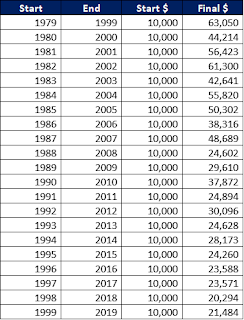
I'm running a 20 year experiment - that is to achieve a net worth of 1 million dollars in 20 years time. Why is it an experiment? Because it is based on investing in the stock market and stock market futures are unpredictable. If we can't forecast the future, does that mean we should do nothing ? Probably not. We can at least have a look at history to get a feel of what might happen ( history does not repeat, but it does rhyme - Mark Twain ). So, lets have a look at what 20 years of investing look like. For example, what if I had started investing 20 years ago ( 1999 ), how much would my net worth be if I cash out end of this year ( 2019 ) . If we take the All ORDS index as a proxy for returns - The All ORDS index was roughly 3153 at the end of 1999 and I estimate it to be roughly 6773 end of this year. That means 10,000$ invested in 1999 would be roughly 21,484$ end of this year.  How about if we started end of 1998 instead and cashed out end of 2018? The All ORD...
On... a Risky Business

I told a good friend of mine that I was going to start investing in the stock market and his response was far from unexpected. "You're either going to make a lot of money or lose a lot of money. The stock market is risky". Is it truly though? Generally, risk can be defined as a permanent loss of capital . That also usually happens when you don't know what you're doing. So, is investing in the stock market a risky business? Based on the two criteria I mentioned, I would say it depends ( meaning it can be risky or not risky ). Confused? First criteria - permanent loss of capital . Sure, you can lose money investing in the market but..... how much you lose depends on you. Say you invest in a property which costs 500,000$ and the price of the property drops by 10%, you would have lost 50,000$ when you sell it. On the other hand, you invest 1,000$ in the market and you lost 100% of it. You would have only lost 1,000$ ( yes, you can invest as little as 1,000$ and...

On... the 10 Dollar Man

Ever heard of the 10 Dollar Man? Probably not - because that's me. This was a name given to me back in my early working days because of my frugal spending habits - 10 Dollar per day for meals ( Dollars as in Malaysian Dollars when I was still working and living in Malaysia ). So, how it works is that I have a 10 Dollar budget  allocated for meals each day and I stick strictly to  the plan.  If I had overspent on breakfast, I would either scale down lunch/dinner or skip a meal. That was how cheapskate I was.   How did I manage to spend so little and why? Well, initially it was maybe out of necessity and it probably became a habit. Less than a year into my job, I had purchased a house and the mortgage was more than 50 percent of my take home salary. In addition, I was a little paranoid to how long my job would last, so I ploughed as much money as I can into...

On… Personal Finance

When you visit a financial planner, you don’t ask questions first - the financial planner does . Why? Because everyone’s financial circumstances are different and the planner has to understand your situation to make  a plan that works for you. There is no one size fits all solution. After all, personal finance is personal. Here’s a few stories…. I have a friend who is rich enough to retire if he chooses to. However, he plans to build a mansion, and that would put him in debt for many years to come. Is living in a mansion better than financial independence and early retirement ? I don’t know. Maybe. My wife’s ex-colleague quit his job as a professional in a mining company to become a park ranger. He would probably be earning much less in his new job but he would be enjoying his new career more. Is job satisfaction more important than money? I don’t know. Maybe. My mother in law has a friend who has been separated from her husband for more than 10 years, living onl...

On… Trading Time for Money

It is said that time is money . I guess they are different sides to a coin. When you’re young, you have time, but no money (exc luding the top 10% of people born to rich parents ); when you’re old you have money but no time. The best of course is to have a happy middle.     Technically if you work hard, you can earn lots of money and the sky is the limit. But no matter how much effort you put in, you can only have 24 hours in a day. There is no way that you can extend it to 25 hours. That much is obvious. If time is finite and scarce, why then do people live as if they have all the time in the world? I think its because people are generally over confident in nature. They over-estimate the time that they really have. People think they can live forever until they realize they can’t. Of course we have to work hard and earn money - How else are we going to buy the things we need to live? We should of course build up a nest egg for retirement as well. Otherwise, you may...

On... the Fear of Negatives

Image
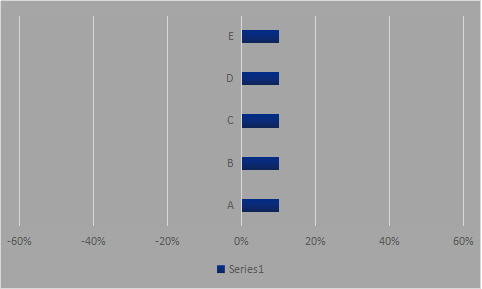
I shared my Quarterly Performance with a friend recently and he came back with the response “Why are there so many negatives ?”. That may be a polite way of saying - your result is quite poor. Its definitely better to have all positive returns and no negatives, but in the stock market, not only is that near impossible but it might not actually matter too much. If ( and that’s a big IF ), you had good portfolio/capital allocation, the negative return on single stocks don’t really matter much . Lets have a look at 3 hypothetical scenarios. Each scenario has a total investment of $100 split over 5 stocks - A, B, C, D and E, with different P/L ( profit/loss ) and portfolio allocation. Scenario 1 - each stock in the portfolio has a 10% return   Scenario 2 - stock A has 30% returns but the rest have negative 50% returns Scenario 3 - stock A has negative 30% returns but the rest have 50% returns Which scenario as an investor would you like your portfol...

On... Coin Flips

Image
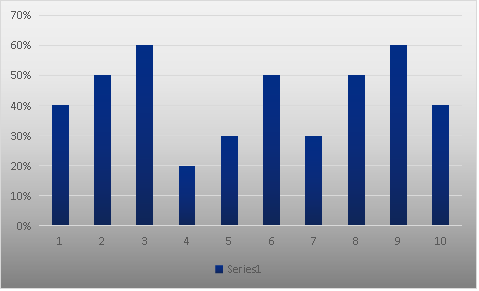
I first came across the coin flip discussion in Nick Maggiulli’s blog post . Here is my simplified and slightly different take on the subject . Assume I offer you a coin flip bet, in which, you earn 60$ if the coin lands on head and you pay 50$ if the coin lands on tail, would you play? Of course you would. How can you lose money in such a game?  I simulated 10 scenarios of  10 consecutive flips; and Scenario 4 ( worst case scenario ) came out as follows:- HEADS, HEADS, TAILS, TAILS, TAILS, TAILS, TAILS, TAILS, TAILS, TAILS. Only 2 flips out of 10 came out heads, which is a probability of 20%. Whats happening? Is the coin rigged? Isn’t a coin flip supposed to have 50% probability? The chart above shows the results of all 10 simulated scenarios ( chart showing probability of flipping heads ); and it apparently isn’t 50%??!!!. In fact, the range is quite wide with scenarios ranging from 20% to 60%. The chart below  shows the money lost/gained for each c...